
A practical guide for real estate agents to provide useful property information without overcomplicating the appraisal process.
When a property goes under contract or is listed for sale, real estate agents often have valuable information that can help an appraiser develop a credible opinion of market value. From recent renovations to comparable sales with unusual circumstances, agents frequently know details about a property and its surrounding market that may not be readily available through the MLS.
Providing this information in an organized appraisal package can be incredibly helpful. However, the goal is not to create a thick packet of paperwork or convince the appraiser that a property should meet a particular value. The goal is to provide accurate, relevant information that the appraiser may not otherwise have.
A well-prepared appraisal package should be concise, factual, and focused on the property, its improvements, and the most relevant comparable sales.
For additional tips on preparing a property for an appraisal, see our guide on how Realtors can prepare for an appraisal.
Here is what to include.
1. A Detailed List of Property Upgrades and Improvements
One of the most valuable pieces of information an agent can provide is a detailed list of improvements made to the property.
The MLS may indicate that a home has been "updated," "renovated," or "remodeled," but these descriptions often lack the detail necessary to understand the actual scope of the work.
For example, a listing may state that a home has a remodeled kitchen. However, there is a significant difference between replacing cabinet hardware and completing a full kitchen renovation.
When preparing an upgrade list, include the following information whenever available:
Description of the improvement: What was actually completed?
Extent of the work: Was the improvement a complete replacement, partial renovation, or cosmetic update?
Date of completion: When was the work completed? If the exact date is unknown, provide an approximate year.
Cost of the improvement: What was the approximate cost, if known?
Supporting documentation: Receipts, permits, contractor invoices, or other documentation may be helpful when available.
Examples of useful upgrade descriptions
Improvement Helpful Details
Roof replacement Entire roof replaced in 2022; approximate cost of $18,000
Kitchen renovation New cabinetry, quartz countertops, appliances, and flooring; completed in 2024
HVAC replacement New 5-ton HVAC system installed in 2023; approximate cost of $12,000
Flooring Luxury vinyl plank installed throughout the main living areas in 2021
Pool New pool constructed in 2020; approximate cost of $65,000
Windows 12 of 18 windows replaced in 2022; remaining windows are original
The more specific the information, the better.
If an improvement was only partially completed, make that clear. If the cost is unknown, simply leave it out. There is no need to estimate a cost just to fill in the information.
As discussed in our guide on how appraisers determine market value, the cost of an improvement does not necessarily equal the amount it contributes to market value. An appraiser will consider the improvement in the context of the market, the property, and comparable sales.
The purpose of the upgrade list is to help the appraiser understand the property's condition, quality, and improvements—not to establish a dollar-for-dollar value increase.
2. Comparable Sales Used to Price the Listing
If you have researched comparable properties to establish the listing price, share them with the appraiser.
If you are still developing a pricing strategy, our guide on how to price a home correctly in today's market explains how to evaluate comparable sales and current market conditions.
These properties can provide valuable insight into the market and the reasoning behind the listing price.
You do not need to print the entire MLS listing sheet or create an elaborate comparative market analysis. A simple list containing the following information is sufficient:
Property address
Sale price
Sale date
For example:
Comparable Property Sale Price Sale Date
123 Main Street $425,000 08/15/2026
456 Oak Avenue $440,000 09/02/2026
789 Desert View Drive $435,000 09/18/2026
The appraiser can typically access the MLS data independently. Providing the address, sale price, and sale date makes it easy to identify the property without unnecessary paperwork.
The most important part is explaining why you selected these properties.
Are they similar in size, age, condition, location, or features? Do they represent a particular segment of the market? Are they recent sales that reflect a change in market conditions?
A brief explanation can be much more useful than a stack of printed MLS sheets.
3. Important Details About Comparable Sales That May Not Be in the MLS
This is where a real estate agent's firsthand knowledge can be especially valuable.
The MLS provides a substantial amount of information, but it does not always tell the entire story of a transaction.
If you are aware of circumstances that may have influenced a comparable property's sale price, share those details with the appraiser.
Examples include:
Unusual financing: Was the buyer's financing structured in a way that may have affected the sale price?
Seller concessions: Were there significant concessions, credits, or incentives provided by the seller?
Property condition: Did the property have significant deferred maintenance, damage, or other issues?
Sale circumstances: Was the property sold through an estate, foreclosure, relocation, or other unusual situation?
Motivated parties: Was there an unusual degree of urgency on the part of the buyer or seller?
Unusual features: Did the property have a feature or deficiency that materially affected its appeal or marketability?
Other transaction details: Was there anything else about the sale that could help explain the price?
For example, a comparable property may have sold for less than other similar homes because it required a new roof, had significant deferred maintenance, or was sold under unusual circumstances.
That information may help the appraiser understand whether the sale is representative of the market.
Understanding these factors can also help Realtors identify potential valuation concerns before they become a problem. Learn more in our article on what can cause an appraisal to come in low.
However, it is important to distinguish between verified information and speculation. If you do not know the details of a transaction, do not present assumptions as facts.
A simple statement such as, "The property reportedly required a full roof replacement at the time of sale," can be helpful, provided the information is accurate and its source is clear.
4. Property Details That May Not Be Available Through the MLS
Agents often have firsthand knowledge of a property that is not reflected in the listing data.
This information can be particularly useful for properties with unique features, rural characteristics, extensive improvements, or unusual layouts.
For properties with acreage, detached structures, unusual improvements, or unique layouts, our article on why complex properties are difficult to price explains why additional property details can be especially important.
Consider including details such as:
Additional living areas or finished spaces that may not be accurately described in the MLS
Detached structures, workshops, guest houses, or accessory dwelling units
Functional differences between the subject property and comparable sales
Unusual site improvements, such as extensive landscaping, outdoor kitchens, or covered patios
Property features that may be difficult to identify through public records
Known zoning, access, or utility considerations
Information about the property's layout, functionality, or condition that may not be immediately apparent
For example, a property may have a detached workshop with electrical service, a separate guest suite, or an extensive outdoor entertaining area.
These details may be relevant to the appraisal, particularly if they are not adequately represented in the MLS.
If you are providing information about square footage, permitted improvements, or other measurable characteristics, make sure the information is accurate and supported when possible.
For more information about how residential square footage is measured and reported, see our guide to ANSI measurement standards.
The appraiser will independently verify relevant property characteristics and determine how they should be considered in the valuation.
5. Keep the Package Concise and Organized
A useful appraisal package does not need to be complicated.
In most cases, a few well-organized pages containing the most relevant information are far more helpful than a large packet of paperwork.
A simple format might include:
Property information: Address and a brief description of the property.
Upgrades and improvements: A detailed list of improvements, including dates, scope, and costs when known.
Comparable sales: Addresses, sale prices, and sale dates.
Comparable sale details: Any verified information about unusual transaction circumstances or property conditions.
Additional property details: Relevant features or characteristics not adequately represented in the MLS.
Avoid including excessive marketing materials, duplicate MLS sheets, unrelated sales, or lengthy explanations that do not provide meaningful information.
The objective is to make the appraiser's job easier—not to create more work.
A concise package that highlights the most relevant information allows the appraiser to spend more time analyzing the property and the market.
6. Understanding Appraiser Independence Requirements (AIR)
While providing property information and comparable sales is encouraged, there is an important distinction between providing relevant information and attempting to influence an appraiser's opinion of value.
Appraisers are required to develop independent, impartial, and objective opinions of value. Their conclusions must be supported by relevant market data and appropriate appraisal methodology.
The Appraiser Independence Requirements (AIR), along with applicable federal laws and regulations, are designed to protect the independence of the appraisal process.
For a related discussion of appraisal concerns and the appropriate way to address them, see our article on what can cause an appraisal to come in low.
Real estate agents, lenders, and other parties may provide factual information, request clarification, or identify additional comparable sales. However, they cannot improperly influence the appraiser's valuation conclusion.
Examples of inappropriate conduct may include:
Demanding that an appraiser reach a specific value.
Threatening to withhold future business because of an appraisal conclusion.
Offering additional compensation in exchange for a particular value.
Conditioning payment or future assignments on the appraiser reaching a predetermined value.
Misrepresenting property information or comparable sales to influence the appraisal.
Certain forms of coercion, improper influence, or inducement are prohibited by federal law and can result in serious consequences, including civil penalties and potential criminal liability, depending on the circumstances.
It is also important to remember that the appraiser is not obligated to use the comparable sales provided by the agent. The appraiser must independently determine which sales are most appropriate for the assignment.
The best approach is to provide information, not instructions.
You can explain why you believe a particular comparable sale is relevant, identify an improvement that may not be reflected in the MLS, or provide additional context about the market.
What you cannot do is dictate the appraiser's conclusion.
A professional appraisal package respects the appraiser's independence while providing the information necessary to develop a credible opinion of value.
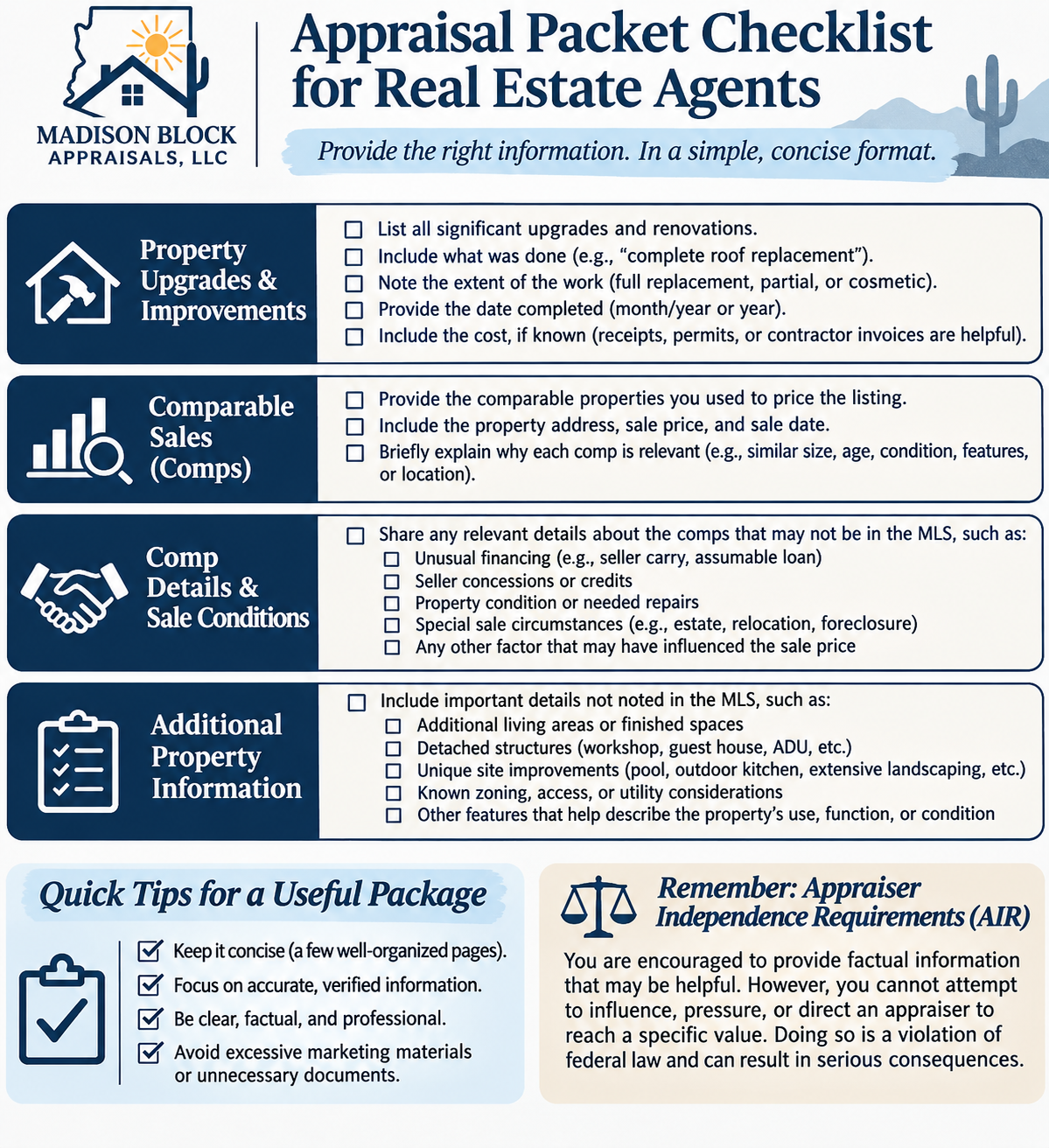
A Free Resource Just For You!
Feel free to use our checklist to help you create your appraisal packet.
Final Thoughts
Real estate agents and appraisers share a common goal: providing accurate, reliable information about the real estate market.
A thoughtfully prepared appraisal package can help bridge the gap between the information available through the MLS and the firsthand knowledge an agent has about a property and its market.
The most effective packages are not the longest. They are the ones that provide accurate, relevant, and well-supported information in a format that is easy to review.
When preparing an appraisal package, remember:
Accurate information. Relevant comparable sales. Detailed upgrade history. Concise presentation. Respect for appraiser independence.
That is what makes a truly useful appraisal package.
At Madison Block Appraisals, LLC, we appreciate Realtors who provide organized, relevant information and communicate clearly about the property. It makes the appraisal process easier for everyone and can help prevent avoidable delays or misunderstandings.
If you're preparing to list or sell a property and need an independent opinion of market value, Madison Block Appraisals provides residential appraisal services throughout Pima, Pinal, and Maricopa Counties. We also offer pre-listing appraisal services for homeowners and Realtors who want a better understanding of a property's market value before it goes under contract.
For properties with unusual features, extensive improvements, acreage, or outbuildings, providing accurate information upfront can be particularly valuable.
The best time to think about appraisal risk is before the appraisal is ordered.
Have a question or want to get a quote? Reach out, we would love to hear from you!
